
WHEN THE STAKES ARE HIGH, VICTIMS CHOOSE LEVY KONIGSBERG
SOCIAL MEDIA INJURY LAWSUITS
SOCIAL MEDIA INJURY LAWSUITS
Introduction to Social Media Injury Lawsuits
Social media injury lawsuits allege that major platforms contributed to addiction, mental health harm, eating disorders, and youth injuries through addictive design and algorithms.
Social media platforms such as Facebook, Instagram, TikTok, Snapchat, and YouTube are widely used across the United States and globally, particularly by children and adolescents. These platforms are operated by large technology companies and are designed to encourage prolonged engagement through features such as algorithmic content delivery, notifications, and continuous scrolling.
The explosive growth of social media platforms has transformed the way we connect, share, and consume information. While these platforms offer significant benefits, such as instant communication and entertainment, they have also given rise to a host of mental health issues. Excessive social media use is increasingly linked to social media addiction, eating disorders, and a range of other mental health problems, especially among young people. As awareness of these risks grows, a wave of social media lawsuits has emerged, targeting social media companies for prioritizing user engagement and profit over the well-being of their users. These legal actions seek to hold social media platforms accountable for their role in fostering media addiction and contributing to the youth mental health crisis. By shining a light on the connection between social media use and mental health, these lawsuits are pushing for greater responsibility and change within the tech industry.
Levy Konigsberg represents individuals and families pursuing social media injury lawsuits alleging that platform operators prioritized user engagement and revenue while allegedly failing to protect users—especially minors—from foreseeable psychological and physical harm.
If you or a loved one was harmed, contact us today.
Were you or someone you love injured or exploited through social media?
Background on Social Media Addiction
Social media addiction has rapidly emerged as a significant public health concern, affecting millions of users across the globe—especially young people and adolescents. The widespread use of social media platforms like Facebook, Instagram, and TikTok has transformed the way we communicate and interact, but it has also introduced new risks to mental health and emotional well-being. The addictive nature of social media apps is no accident; social media companies have engineered their platforms to maximize user engagement through features such as endless scrolling, personalized notifications, and instant feedback. These design choices stimulate the brain’s reward centers, making it increasingly difficult for users to disengage and leading to excessive social media use.
For young users, the consequences of social media addiction can be particularly severe. Excessive social media usage has been linked to a range of mental health issues, including depression, anxiety, eating disorders, low self-esteem, and even suicidal ideation. The constant exposure to curated images and unrealistic standards can foster negative body image and disrupt real life relationships, while the pressure to stay connected online can erode interpersonal relationships and hinder healthy social interaction. As a result, so many children and young adults are now facing a youth mental health crisis fueled in part by problematic social media use.
The tech industry, and social media giants in particular, have come under increasing scrutiny for their role in perpetuating media addiction. Internal company documents uncovered during the discovery process in social media lawsuits have revealed that some social media companies were aware of the psychological or physical harm their platforms could cause, yet continued to prioritize profits and user engagement over user safety. This has drawn comparisons to the tactics once used by tobacco companies, who denied the dangers of their products despite mounting evidence.
Legal action is now being taken against these tech giants, with social media lawsuits filed in federal court and state courts such as the Los Angeles Superior Court. These cases often allege that social media companies failed to provide age-appropriate experiences, neglected to warn users of the risks, and violated consumer protection laws and federal law, including the Communications Decency Act.
Concerned parents, advocacy groups, and legal teams are calling for more transparency, accountability, and safeguards to protect young users from the dangers of excessive social media use. There is a growing consensus that the tech industry must be held accountable for its role in the youth mental health crisis, and that individuals and families affected by social media addiction deserve support and, where appropriate, monetary compensation for the harm suffered.
In a very real sense, social media addiction is not just a personal issue—it is a public health crisis that demands immediate action from tech companies, regulators, and society as a whole. By understanding the background and far-reaching consequences of social media addiction, we can work together to create a safer, healthier, and more balanced online environment for everyone
Current Litigation Over Social Media Liability
The field of social media victims’ litigation is new and evolving. But there are a growing number of legal cases focused on the risks posed by social media platforms and the responsibilities social media companies have for managing and warning about those risks. School districts have joined lawsuits as plaintiffs, highlighting the impact of social media on student well-being and education.
- In March 2026, a California jury awarded a twenty-year-old plaintiff $3 million in compensatory damages and recommended an additional $3 million in punitive damages against the operators of Instagram and YouTube for alleged negligence and design defects that compromised children’s safety.
Jurors found that the facility operators knew their products were dangerous for children but allegedly failed to provide adequate warnings. Evidence presented during the proceedings highlighted specific features, such as infinite feeds and autoplay, which were allegedly intended to maximize engagement at the expense of children’s mental health.
- In January 2026, a series of landmark trials began in Los Angeles superior court involving allegations that social media companies intentionally designed addictive products that caused mental and physical harm to young people. Approximately 1,600 plaintiffs, including more than 350 families and 250 school districts, alleged that platforms owned by Meta, TikTok, and YouTube led to a lost generation of children who suffered from depression, eating disorders, and self-harm.
- In January 2026, Snap settled a lawsuit filed in Los Angeles regarding social media addiction. A nineteen-year-old woman alleged that the algorithmic design of various platforms caused her to become addicted and damaged her mental health. The legal claims argued that the companies deliberately designed their platforms to hook users through specific choices involving notifications and algorithms. While Snap reached an amicable resolution for an undisclosed amount, other companies including Meta, TikTok, and YouTube remained as defendants. These platforms allegedly caused harm such as eating disorders and depression.
- In August 2025, numerous families and school districts pursued legal action in California against social media companies, claiming that addictive algorithms and specific design features caused mental health issues in children. These proceedings involved two main legal actions, including a consolidated group of personal injury cases in Los Angeles County Superior Court and a federal proceeding in the Northern District of California. According to court filings from June 2025, the state-level action included 2,481 personal injury cases. The plaintiffs in these lawsuits allegedly claimed that the social media products were defective and should be held to product liability standards. Students allegedly suffered from sleep deprivation, anxiety, and other mental health harms, causing schools to divert resources to manage the resulting student crises.
- In March 2023, a lawsuit filed against various social media companies – including Meta Platforms, Inc., Instagram LLC, Snap, Inc., TikTok, Inc., ByteDance, Inc., YouTube LLC, Google LLC, and Alphabet Inc – was consolidated into a multi-district litigation (MDL) in the Northern District of California. The suit raises claims that the companies’ platforms are defective because they are designed to maximize screen time, encourage addictive behavior in adolescents, and cause emotional and physical harm, including suicide and death. These cases are being heard in federal court, and similar high-profile trials are also taking place in the Los Angeles Superior Court. Defendants include major platforms such as YouTube parent Google and Facebook Instagram, as well as various social media platforms. Working with an experienced legal team is crucial in these cases to navigate complex legal procedures, gather necessary evidence, and maximize the chances of a successful outcome.
- In June 2022, a personal injury lawsuit filed against Meta Platforms, Inc. and other defendants raised claims that social media algorithms and AI programs are intentionally designed to be addictive to minors, who can easily become depressed, victimized by cyberbullying, or develop other mental health issues, including self-harm and suicidal behavior. The suit (Guerrero v. Meta Platforms, Inc., et al) was filed on behalf of a 17-year-old whose addictive and problematic use of Meta social platforms resulted in sleep deprivation, an eating disorder, severe anxiety, and attempted suicide. Plaintiffs in these cases are seeking monetary compensation for the harm caused by excessive social media usage.
- In October 2021, former Facebook employee Frances Haugen testified before the U.S. Senate to discuss how Facebook harms children in pursuit of “astronomical profits.” In her written testimony, Haugen stated that the company consistently chose to maximize growth rather than implement safeguards on its platform, despite mounting evidence of the harm it was causing individuals and children. Internal company documents and internal documents have been presented as key evidence in court to show that these companies were aware of the risks but failed to act. During the discovery process, legal teams may also seek to access social media data from electronic devices and platforms to support their claims and further demonstrate the impact of social media addiction.
Addressing social media addiction and its consequences can have significant benefits for mental health and emotional well-being, especially among youth and young adults.
Suing Social Media Platforms for Addiction and Self-Harm
Social media companies have become some of the world’s largest corporations. But in their efforts to grow, keep users engaged, and maximize profits, they have created algorithms and environments that are not only harmful but, in some cases, exploitative, especially to children. These social networking sites are often intentionally designed as addictive social media, fostering compulsive use and dependency among users.
Now, parents of children and teens who’ve suffered injuries, losses, or trauma—including sexual abuse—because of their social media use are stepping forward to hold these companies accountable. Excessive use of these platforms has been identified as a key factor leading to such harms, particularly among young people who are especially vulnerable. Problematic social media use is now recognized as a significant issue, further contributing to the need for legal action.
At Levy Konigsberg, we’re leading the fight for families seeking justice against these powerful platforms, with a focus on protecting youth mental health.
How Can Social Media Companies Be Held Liable?
While cases vary in their particularities, social media injury lawsuits are often based on a few common claims, including:
- Negligence in creating, maintaining, and supervising platforms for the presence of harmful or dangerous content, including harmful content accessible to minors and content that facilitates abuse.
- Failure to adequately warn about serious mental and physical health risks associated with their products.
- Failure to exercise reasonable care in the development and design of their products, as well as the operation, supervision, and promotion of their platforms and content.
- Defective products, including algorithms and technologies that promote harmful or dangerous content to vulnerable users like children.
- Defectively designed platforms and algorithms that are intended to maximize screentime, thereby promoting addictive behavior and creating unreasonable risks for mental and physical harm. These online platforms implement features specifically designed to maximize user engagement, such as infinite scrolling and personalized notifications, which keep users on the platform for longer periods. Such features target the brain’s reward centers, stimulating dopamine release and reinforcing compulsive use. The instant feedback provided by likes, comments, and shares requires minimal effort from users, further encouraging ongoing engagement and reinforcing addictive behaviors. Social media addiction is increasingly recognized as a form of behavioral addiction, similar to gambling, with significant psychological and physical impacts. This broader phenomenon is often referred to as media addiction, encompassing the compulsive use of digital and social media platforms.
As a firm that has earned national recognition litigating tobacco lawsuits and other products liability cases against large corporations, we see many similarities between social media companies and Big Tobacco. This includes a careful construction of products that are designed to exploit human biology and neurology, with a focus on maximizing engagement, dependence, and addiction. Major social media platforms are often operated by a parent company, such as Meta for Facebook and Instagram, which adds another layer of corporate structure to legal and regulatory challenges. The tech industry as a whole has historically received regulatory leniency, allowing these companies to grow rapidly with minimal oversight.
For social media companies, extreme and constant engagement is a great way to boost advertising revenue. But for users and especially youth, it is a highly dangerous objective that clearly indicates these companies are more interested in maximizing profits than protecting the health and safety of people. These online platforms are now facing legal scrutiny under consumer protection laws, which are being applied to hold them accountable for unfair practices and failure to warn users of health and safety risks. Legal claims also challenge the protections provided by federal law, specifically Section 230 of the Communications Decency Act, which has traditionally shielded platforms from liability for user-generated content and certain design choices.
By pursuing claims against social media companies, victims can position themselves to secure the justice and compensation they deserve and help forge a path to better regulate this space and enact positive change in the ways these companies operate and protect young users.
Research Reveals Social Media’s Negative Impact on Children
Social media sites like Facebook, Twitter, Instagram, TikTok, Snapchat, and others have changed the way people interact with others, view themselves, and spend their time. Social media usage is now extremely prevalent among youth, shaping their daily routines and social interactions. While social interaction on social media can foster connections and provide a sense of community, excessive or superficial social interaction via these platforms can negatively impact mental health, hinder the development of social skills, and disrupt real-world relationships. In adolescents, this can sometimes lead to social isolation or impaired social development. Those changes can be felt among users of all age groups, but for children and younger generations, it’s all they’ve ever known.
Now, growing research is showing just how dangerous social media can be for the mental health of younger users, especially in terms of rising teen suicide rates. Excessive social media use has been linked to a range of negative outcomes, including increased anxiety, depression, and disruption of real life relationships and interpersonal relationships.
For example:
- In July 2025, a Pew Research study indicated that a significant portion of American teenagers experienced compulsive behaviors regarding social media. Social media use resulted in specific personal harms for many young users. According to the findings, 45% of teens allegedly claimed social media hurt their sleep, and 40% alleged it negatively impacted their productivity. Additionally, 19% of teen girls allegedly reported that social media use damaged their mental health. While many teens allegedly viewed the impact on their peers as negative, 39% specifically alleged they felt overwhelmed by drama on the platforms.
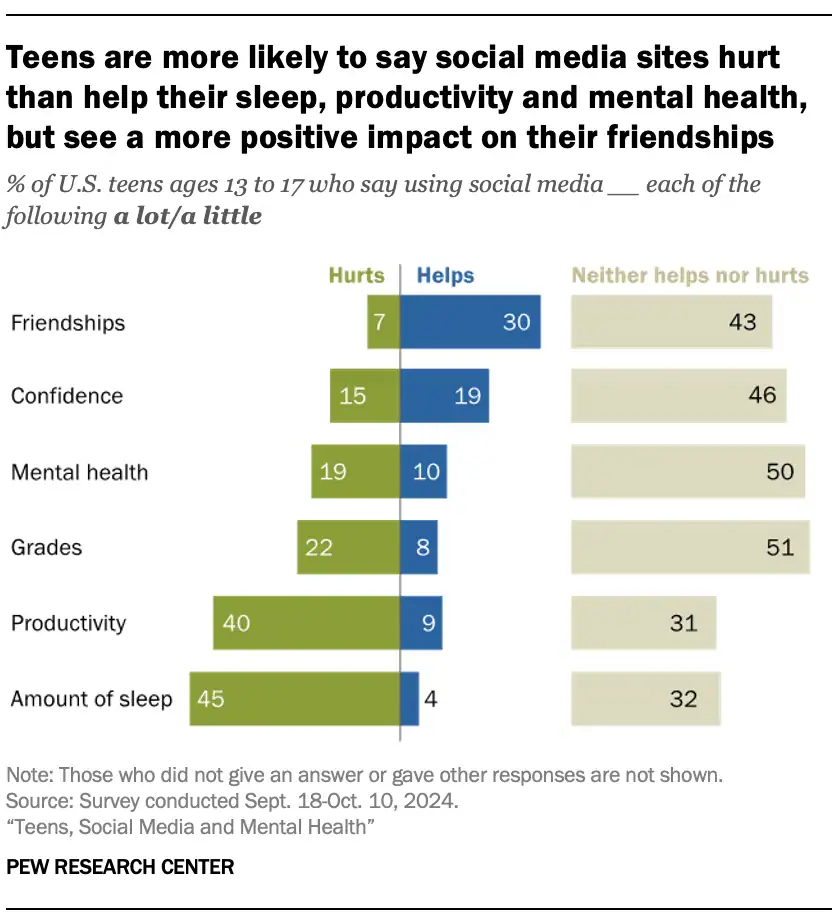
Photo courtesy of the Pew Research Center
- In November 2023, a study of Norwegian adolescents allegedly discovered a direct link between extended social media use and physical injury. The research allegedly found that teenagers who spent more than three hours every day on social media platforms had a higher chance of engaging in self-harm. This increased risk allegedly applied to both boys and girls across all school grades. Furthermore, the study allegedly noted that this connection between high screen time and self-harm existed regardless of whether the adolescents already suffered from severe symptoms of depression.
- In August 2017, CDC data and peer-reviewed studies logged with the National Library of Medicine show that the teen suicide rate has increased over 30% between 2007 and 2015. Researchers have pointed to the proliferation of social media use by this age group as a potential cause. Excessive social media usage has been shown to negatively impact mental health, leading to mental health problems and, in some cases, users have developed mental health issues such as depression and anxiety.
- In November 2018, a Pew Research Center study found that a heightened risk of suicidal ideation among teens coincided not only with the amount of time users spent on social media, but also with the type of content they consumed. The study found that teens who used social media two or more hours per day suffered a decline in mental health, regardless of content consumed, and that teens who engaged in personal posts (selfies, journaling, etc.) faced a higher risk of suicidal ideation than those who used platforms for entertainment. Teens who experienced cyberbullying had the highest risk of suicidal ideation. Excessive social media use can also lead to compulsive checking, which reinforces negative emotions and can further harm mental well being and emotional well being.
Many other scientific studies have explored the dangers of social media use by teens and have found compelling evidence that these platforms create toxic atmospheres for young users whose brains are still developing. Negative emotions such as jealousy, anxiety, and social isolation are common results of problematic social media use.
Some examples:
- A 2022 study published in NASN School Nurse found that social media can lead to increased feelings of stress, isolation, and indirect or direct criticism for adolescents, whose introduction to social media often coincides with a time of tremendous emotional and developmental vulnerability. These negative effects can extend to young adults, who are also a vulnerable group.
- A 2022 study published in Current Psychology noted that social media use in adolescents resulted in negative psychological feelings about oneself. It also found that in viewing content on these platforms, adolescents often made comparisons to their own body image, life experiences, and abilities and that increased time on social media was associated with increased risks of depression, poor academic performance, disordered eating, and dissatisfaction with body image. Negative body image and low self esteem are common outcomes, and social media can distort one’s perception of their own life, leading to further emotional distress.
- A 2020 study published in PloS One found that Instagram, compared to other social media platforms, contained the greatest proportion of visual self-harm content. Images of self-harm also received high levels of engagement from users. Exposure to such content can contribute to dangerous behaviors and exacerbate mental health problems.
- A 2017 study published in the scientific journal EWD concluded that social media can result in negative views of an individual’s self-image, especially in relation to body image and disordered eating. It linked high levels of Instagram use to a higher prevalence of orthorexia nervosa (obsession with healthy eating), an effect that wasn’t exhibited by other platforms. Excessive social media can also disrupt real life relationships and lead to problematic social media use.
Eating Disorder and Social Media
The relationship between social media and eating disorders is a growing concern, particularly for young users. Social media platforms are filled with curated images and content that often promote unrealistic beauty standards and lifestyles. This constant exposure can lead to negative body image and low self-esteem, as young people compare themselves to idealized versions of others. Over time, these unhealthy comparisons can contribute to the development of eating disorders such as anorexia nervosa, bulimia nervosa, and binge-eating disorder. In addition, some social media communities actively share and promote pro-eating disorder content, making it even more challenging for vulnerable individuals to recover. The impact of social media use on eating disorders highlights the urgent need for awareness, prevention, and intervention to protect the mental health of young users and foster a healthier online environment.
We specialize in lawsuits against powerful institutions, including government entities, technology companies, and clergy.
CLICK HERE TO SEE IF YOUR CASE QUALIFIES
We work on contingency, which means there’s no cost to hire and no fee unless we win.
Who Can You Sue in a Social Media Injury Civil Case?
In a social media injury case, the parties you might sue depend on the specific platform used, the nature of the harm, and how the service was designed. Some potential parties that could be sued in a social media injury civil case include:
- Social Media Companies: Major tech giants such as Meta (Facebook and Instagram), ByteDance (TikTok), Alphabet (YouTube), and Snap Inc. (Snapchat) are the primary defendants in these cases. Lawsuits allege these companies intentionally designed their platforms to be addictive and failed to warn of mental health risks.
- App Developers and Designers: If a specific app or feature was designed in a way that directly led to an injury or facilitated predatory behavior, the developers responsible for its architecture may be held liable.
- Third-Party Content Providers: While Section 230 often protects platforms from content posted by others, companies may still be sued for their own algorithms that push harmful content or challenges to vulnerable users.
- Individual Harassers or Predators: If the injury involved direct harassment, cyberbullying, or sexual exploitation, the individual perpetrator can be named as a defendant alongside the platform that facilitated the contact.
- Employers or Organizations: If an employee of an organization used social media to cause harm within the scope of their work, the employer might be held vicariously liable for failing to supervise their digital conduct.
Social media injury cases are a rapidly evolving area of law involving complex products liability and negligence claims. It is highly advisable to consult with experienced legal professionals who specialize in tech-related litigation. Levy Konigsberg, along with our team of social media injury lawyers, is available to provide assistance for your case.
Do I Have a Case?
You may have grounds to file a civil legal action if you or your child suffered physical or psychological harm due to social media addiction or platform-related injuries. As civil claims, these cases focus on holding tech companies liable for defective product design and failure to warn. This means you may still have a claim even if:
- The specific individual who harassed or exploited you cannot be identified.
- The harm was caused by an “automated” algorithm rather than a person.
- The platform claims it is not responsible for user-generated content.
- The injury (such as an eating disorder or self-harm) developed over several years of use.
Recoverable Damages in Social Media Injury Claims
Civil lawsuits against social media companies allow families to recover financial compensation for the extensive toll of these injuries, which may include:
- Past medical and mental health expenses: Costs for hospitalization, rehabilitation, or emergency care related to self-harm or eating disorders.
- Future mental health expenses: Ongoing costs for therapy, specialized counseling, and long-term psychiatric care.
- Pain and suffering: Compensation for the physical pain and emotional trauma caused by the platform’s impact.
- Educational losses: Damages for missed school, tutoring costs, or diminished educational opportunities due to addiction or mental health struggles.
- Lost income: Financial recovery for parents who had to leave work to care for a child, or for young adults whose earning capacity was impacted.
- Punitive damages: In some cases, courts may award these to punish companies for intentionally designing addictive features while knowing the risks to minors.
Our lawyers are actively investigating potential lawsuits from parents and families with children who have suffered from addiction, depression, or physical harm on social media platforms.
Trust Levy Konigsberg’s Legal Team for Proven Results in Social Media Injury Lawsuits
Levy Konigsberg LLP, a nationally recognized law firm, has built a legacy over three decades, recovering over $3 billion in compensation for clients. Led by award-winning lawyers, we specialize in taking on powerful institutions. Our top-rated trial practice handles all types of negligence cases, showcasing numerous testimonials and successful case results.